
Look Up Dunwoody Neighbors
A block lookup begins with land, not a list of household members. DeKalb parcel polygons show which lots touch or face an address. Tax profiles attach public owner and mailing details to each parcel. Dunwoody permits show work tied to nearby sites, while a lawfully obtained voter file may contain registered voters at addresses. Private community directories add a social layer only for authorized members. Each source answers a different question, and none is a complete roll of everyone who lives nearby.
| Block source | What the record can show | How to reach it |
|---|---|---|
| DeKalb parcel polygons | Adjacent parcels, site addresses, owner and land facts | Free GIS search, zoom, and identify |
| Property appraisal profiles | Owner, mailing and situs addresses, exemptions, sales | Free portal; query each parcel ID |
| Dunwoody permit portal | Street-wide permits, work, dates, and named contacts | CentralSquare site-address search |
| Voter list | Lawfully released address rows with protected fields removed | Paid state or county extract, not MVP browsing |
| Community directories | Consenting member households or contacts | Authenticated members only where offered |
An owner is not always an occupant. A matching mailing address and homestead exemption may support owner occupancy, but neither reveals every person in the household. Renters, roommates, children, and relatives may be absent. Keep the record's own label: owner, applicant, contractor, voter, or association member. Do not turn that label into an unsupported claim about who lives there.
Dunwoody Parcel Map Controls
The DeKalb County GIS Hub is the best first view of nearby parcels. Its official parcel layer includes site address, parcel ID, owner, postal address, subdivision or condominium, lot and block, plat book and page, values, zoning, acreage, frontage, and geometry. The public viewer may offer fewer controls than the data service, but an address search, map pan, and parcel click are enough for most block work.
| Map control | Input | Use on the block |
|---|---|---|
| Address | Street number and name | Zoom to the target site |
| Parcel ID | County parcel key | Open one exact tax lot |
| Zoom and pan | Map movement | Frame touching and opposite lots |
| Identify parcel | Click a polygon | Read the public attributes |
| Layer list | Parcels, zoning, aerial map | Compare boundaries and setting |
GIS is a tax and planning tool, not a survey. It cannot settle an encroachment or exact boundary dispute. Use a recorded plat or professional survey for that purpose.
Map Dunwoody Neighbor Blocks
House numbers are a poor guide to physical proximity. Cul-de-sacs, flag lots, condos, and irregular parcels can make the next number much farther away than an address across the street. Use the polygon shape to decide which properties count as the immediate block around your starting point.
- Locate the target in DeKalb GIS and zoom until its whole polygon and nearby lots are visible.
- Click each touching parcel and each lot directly opposite. Record the parcel ID and situs address.
- Open each parcel in the Property Appraisal Search. Keep owner mailing and situs addresses in separate fields.
- Check a homestead indicator only as supporting evidence. It does not prove the full household.
- For condos, note that many units may share one mapped shape and require individual parcel searches.
This process flow is address → mapped parcel → adjacent polygons → parcel IDs → tax profiles. Expand to the Dunwoody street directory only when the goal changes from nearby neighbors to a whole named road.
Read Dunwoody Address Labels
DeKalb's official parcel layer gives a useful warning about labels. One inspected Dunwoody parcel had a situs address on Ashford Dunwoody Road, an owner named as an organization, and a separate Chamblee Dunwoody Road postal address using Atlanta as the postal city. All of those fields can be accurate at once.
The situs address is the land location. The postal address is where the owner receives notices. The owner name identifies the taxpayer or title holder. None alone establishes your neighbors as occupants. An out-of-area mailing address may suggest absentee ownership; matching lines may suggest an owner occupant. Both still need care, especially with trusts, corporations, and multi-unit parcels.
Dunwoody Block Permit Activity
The Dunwoody CentralSquare permit search offers a site-address mode with begins with, contains, or equals operators. A broad street fragment can return work up and down the block. Results paginate twenty at a time and offer print and Excel export. Open tabs may include site information, contacts, fees, inspections, chronology, conditions, and reviews.
Dunwoody switched from iWorQ to CentralSquare on August 4, 2025. A legacy application or complaint may need staff transfer help. A permit names a project and often an owner, applicant, or contractor, but none of those roles means the person lives at the address. Use permits to understand nearby construction and dates, not to create a household claim.
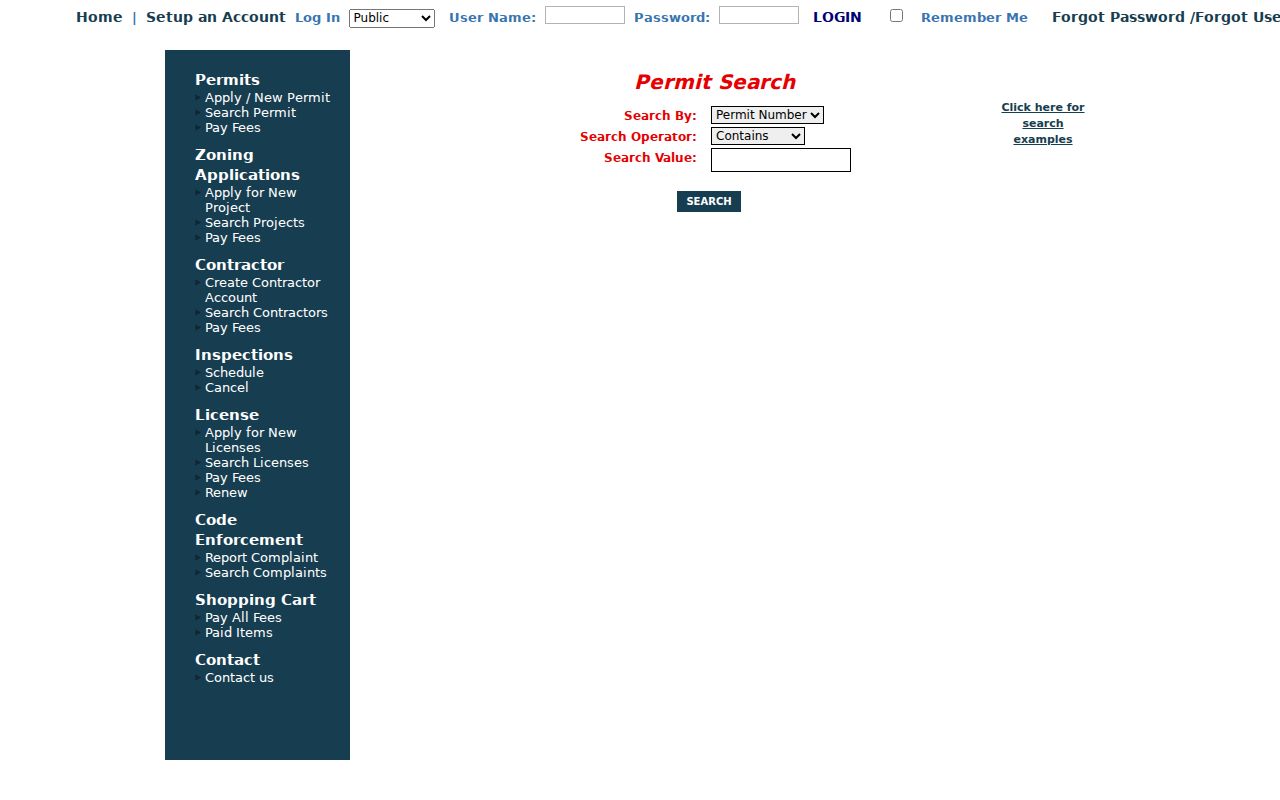
The search form's site-address and owner-name modes provide a practical check when a parcel profile lists permits but not the full city file.
Dunwoody Neighborhood Directory Lines
Planning materials name Dunwoody North, Georgetown, Perimeter Center apartment communities, Dunwoody Village, and Williamsburg. The Dunwoody Homeowners Association, founded in 1969, represents broad residential interests. No official citywide HOA or household directory was found. Public board and contact pages identify organizational roles, not all residents.
| Community resource | Directory status | Proper use |
|---|---|---|
| Dunwoody Homeowners Association | No verified citywide member directory | Public civic and planning contacts |
| Dunwoody Club Forest West | Authenticated resident directory | Authorized resident access only |
| Dunwoody Newcomers Club | Member-only directories | Member networking within access rules |
| Dunwoody North | Historic alphabetical and street formats described | Historical context; current roster not public |
These private rosters can be richer than public records because members choose to share household details. Authentication is a real privacy boundary. Do not copy member entries into an open list or use an old newsletter as proof of current occupancy.
Dunwoody Voter Records by Block
Georgia My Voter Page is an authenticated self-lookup. A voter enters personal details to see registration status, polling place, districts, sample ballot, and participation history. It is not a public street browser for finding Dunwoody neighbors.
A lawfully released state or county voter-list extract is a different record. It may include municipal or precinct address rows, but protected data is excluded. Phone numbers, dates of birth, Social Security numbers, and driver-license numbers do not belong in the public list. Georgia law also restricts commercial use of a list furnished under the election statute. Safe at Home and VoteSafe can shield address information for eligible people.
Official Dunwoody Neighbor Evidence
Official records preserve a clear custodian and a defined field. Commercial neighbor tools may merge parcel, marketing, and other data, then lag behind a sale or move. They can help suggest a spelling, but they are not proof. Always return to the public source before attaching a person to the block.
| Source type | Strength | Limit |
|---|---|---|
| County parcel and tax record | Current official owner and land facts | Does not list every occupant |
| City permit record | Official project, date, and named roles | Contacts may live elsewhere |
| Authorized community roster | Member-supplied local details | Private; access depends on consent |
| Commercial compilation | May combine many sources | Can merge people, lag changes, and lack authority |
Source dates matter as much as source names. The appraisal profile can carry current and historical assessment fields, yet a recent sale or deed may reach one system before another. Permit contacts can remain in an old file after the work ends. An association roster may reflect the member's last update. Write down the date viewed, the role shown, and the custodian. Then check a second official source when identity or occupancy matters. That small audit trail prevents a stale block record from turning into a claim about present-day Dunwoody neighbors.
Dunwoody Neighbor Filing Alerts
A block search often begins as simple curiosity, but owners may also want to watch their own parcel for an unexpected filing. The Georgia Superior Court Clerks' Cooperative Authority operates FANS, the free Filing Activity Notification System. A registered user can receive notice when the index records an event tied to the chosen name or property criteria. DeKalb residents who used the county's older Property Fraud Registry must register again in FANS.
An alert is only a signal that something entered the index. It does not prove fraud, ownership, or occupancy. Open the document and verify it with the DeKalb County Clerk of Superior Court before drawing a conclusion. FANS is most useful for monitoring your own title, not for tracking the routine activity of your neighbors.
Protect Your Dunwoody Neighbors
Public parcel records do not expose a complete household. Utility, customer, and delivery information is not a public neighbor roll. Motor-vehicle addresses are restricted by federal law. Public-record exemptions also protect sensitive identity, financial, and health details. Georgia Safe at Home provides a substitute address and confidential voter registration for eligible survivors, while VoteSafe offers voter-specific protection in qualifying circumstances.
A missing address can be deliberate and lawful. Do not try to defeat a safety program by joining records from several systems. Correct an error with the assessor, clerk, elections office, or city custodian that controls the source. Removing a result from a commercial compilation does not erase a lawful government record.
Lawful use. Look up Dunwoody neighbors for civic curiosity, reconnection, and awareness, never to watch, harass, intimidate, trespass, or evade an order.